
INTRODUCTION
Decades of successful applications have hardly exhausted the potential and vitality of the control technology. On the contrary, new societal imperatives highlight the importance of control, and investments in control technology are taking place in old and new industrial sectors. However, still the answer to the fundamental question: “Is deep control expertise nowadays sufficient to make a significant impact on industry and society?” is an emphatic NO.
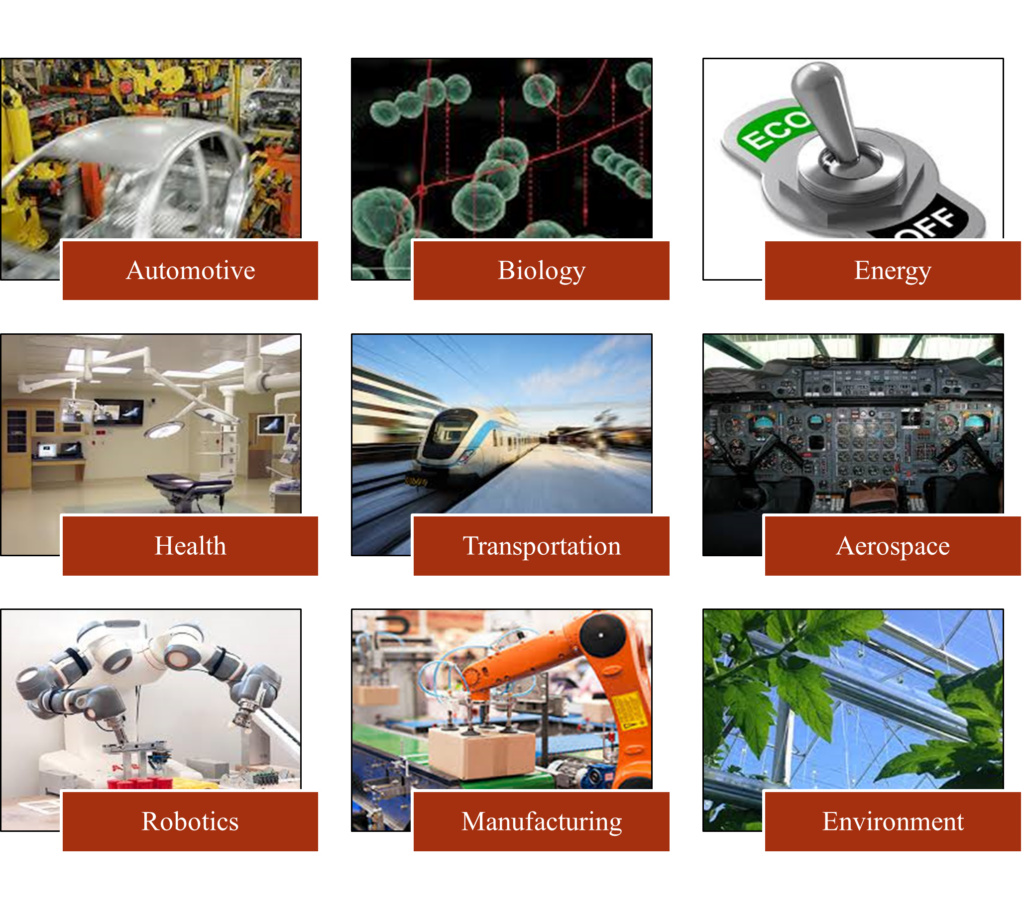
New developments in mathematical systems, control theory and algorithms are needed to meet the challenges, with the focus mainly lying on issues such as robustness, stability and adaptability, and partially on cross-disciplinary endeavors in areas such as complexity, real-time systems and implementation. Towards this direction, the ACCOST project aims at: (i) proposing a consolidated methodology for nonlinear control systems focusing mainly on the issues of robustness and performance in conjunction with the operational constraints that arise either from the actuation level or the sensing and (ii) addressing issues and requirements involved in realizing practical and successful deployments.
For this reason, multiple experimental and realistic simulation studies will be conducted for a variety of application domains in aerial robotics and certain scientific/technological aspects that are critical to understand, while attempting to achieve impact with advanced control, will be examined. In this spirit, the envisioned unifying approach will yield a completely automated control system, which will pave the way towards actual autonomy in various control engineering domains. Notice that the consideration of multiple and probably coupled/conflicting operational constraints as well as their combination towards a unifying control approach call for new ways of thinking and analysis, which render the ACCOST project a beyond the state of the art and ground breaking approach to the field of nonlinear control systems engineering.